

Mental Reasoning 4- Non-Verbal Series: Questions and Step-by-Step Solutions for Competitive Exams SSC, BSSC, Bank, Railways
Non-Verbal Series (Mental Reasoning)
Concept (Basic Idea)
In Non-Verbal Series, problems are given as a sequence of diagrams or figures, and you need to find the next figure, complete the missing figure, or find the odd one out.
👉 It tests your ability to:
- Observe patterns and changes (shape, size, rotation, number, shading, etc.)
- Identify visual logic instead of numeric or verbal logic.
Types of Non-Verbal Series
Here’s the complete list of most probable and exam-oriented types, grouped for clarity.
A. Based on Shape/Pattern Changes
- Shape Addition or Subtraction Series
- A new element (dot, line, or shape) is added or removed each step.
- 🔸 Example:
□ → □● → □●● → ?
➤ Each step adds one dot ⇒ Next will have 3 dots.
- Change in Number of Elements
- Number of figures (e.g., triangles, circles) increases or decreases in sequence.
- 🔸 Example:
▲ → ▲▲ → ▲▲▲ → ?
➤ Next figure: 4 triangles.
- Progressive Addition/Deletion of Lines
- Lines are added or deleted stepwise.
- 🔸 Example:
- | → \| → \|/ → \|/—
One line → Two lines crossing → Three lines → ?
B. Based on Rotation or Direction
- Rotation of Figures
- The shape rotates by a fixed angle (90°, 180°, etc.) in each step.
- 🔸 Example:
An arrow pointing → ↓ ← ↑ ?
➤ Rotates 90° clockwise each time ⇒ Next will point .→
- Mirror Image / Water Image Series
- Figures alternate between their mirror or water image versions.
- 🔸 Example:
- A → mirror A → A → mirror A → ?
➤ Next: A (normal).
- Clockwise / Anticlockwise Movement
- Object parts move around the figure in a fixed direction.
- 🔸 Example:●◻ → ◻● → ●◻ → ◻●
A dot moves corner to corner clockwise around a square.
C. Based on Shading / Filling / Colour Pattern
- Change in Shading
- Black–white pattern alternates or increases/decreases.
- 🔸 Example:○ → ◐ → ● → ?
White circle → Half shaded → Fully shaded → ?
- Alternate Shading Pattern
○ → ● → ○ → ●
- Alternate figures have opposite shades or textures.
D. Based on Position / Movement of Components
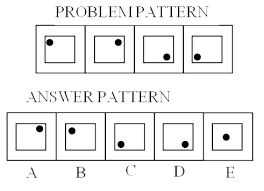
- Movement of Dot, Line, or Small Figure
- A small element (dot, cross, arrow) moves in a fixed path inside a bigger figure.
- 🔸 Example:
A dot moves inside a square from top-left → top-right → bottom-right → ?
➤ Next: bottom-left.
- Division of Figures
- Figure gets divided into smaller parts step-by-step.
- 🔸 Example:
Square → Two rectangles → Four squares → ?
- Combination / Merging of Figures
- Two figures merge to form a new figure in sequence.
△ + ○ → ⊙△ → ⊙
E. Based on Number of Lines, Dots, or Sides
- Number of Lines Increases
- Every step adds a line symmetrically.
- 🔸 Example:
| → + → ✚ → ✤
- Change in Number of Sides
- Triangle (3 sides) → Square (4) → Pentagon (5) → Hexagon (6) → ?
- Change in Angle or Orientation
- Each step changes the angle between parts.
F. Based on Mathematical or Logical Arrangement
- Geometric Progression of Figures
- Figures grow/shrink proportionally in size.
- 🔸 Example:
Small circle → Medium circle → Large circle → ?
- Counting-Based Series
- Count of shapes, lines, or points follows a number series.
- 🔸 Example:
1 dot → 2 dots → 4 dots → 8 dots → ?
G. Based on Enclosed or Overlapping Shapes
- Overlapping Figures
- Overlap increases/decreases per step.
- Number of Enclosures
- Figures within figures (nested squares, circles, etc.) increase or decrease.
H. Based on Figure Completion / Missing Parts
- Part Missing or Rotating
- A portion of the figure moves/rotates in each step.
- Dot Inside Figure Changes Position
- Dots, arrows, or small lines move around corners.
I. Mixed Pattern
- Multiple Changes Together
- Rotation + Shading + Movement combined.
- Common in SSC CGL, RRB, Banking Prelims.
Tips to Solve Non-Verbal Series Quickly
✅ 1. Observe differences between consecutive figures first.
✅ 2. Focus on one change type at a time (rotation, shading, number, etc.).
✅ 3. Eliminate clearly wrong options (non-matching features).
✅ 4. Practice 5–10 questions daily visually.
✅ 5. Avoid overthinking—most series are based on simple repetition or symmetry.
Exam-Level Example (SSC style)
Question:
Find the next figure in the series:
⬜⚫ → ⬜⬜⚫ → ⬜⬜⬜⚫ → ?
Step-by-Step Solution:
- Each step adds one empty square before the black dot.
✅ Next figure: ⬜⬜⬜⬜⚫
1 thought on “Mental Reasoning 5- Non-Verbal Series: Questions and Step-by-Step Solutions for Competitive Exams SSC, BSSC, Bank, Railways”